What: Read the Title!
When: Sunday, October 23rd, 6pm.
Where: Buy the Book, Downtown Daegu
Come join Daegu Green Living for our 11th Eco-Film Night (maybe it's time to stop counting?). This time, we'll be showing "If a Tree Falls: The Story of the Earth Liberation Front."
From the official website, http://www.ifatreefallsfilm.com:
"December 2005, Daniel McGowan was arrested by Federal agents in a nationwide sweep of radical environmentalists involved with the Earth Liberation Front-- a group the FBI has called America's "number one domestic terrorism threat."
For years, the ELF—operating in separate anonymous cells without any central leadership—had launched spectacular arsons against dozens of businesses they accused of destroying the environment: timber companies, SUV dealerships, wild horse slaughterhouses, and a $12 million ski lodge at Vail, Colorado.
Witith the arrest of Daniel and thirteen others, the government had cracked what was probably the largest ELF cell in America and brought down the group responsible for the very first ELF arsons in this country.
IF A TREE FALLS: A STORY OF THE EARTH LIBERATION FRONT tells the
remarkable story of the rise and fall of this ELF cell, by focusing on the transformation and radicalization of one of its members.
Part coming-of-age tale, part cops-and-robbers thrilller, the film interweaves a verite chronicle of Daniel on house arrest as he faces life in prison, with a dramatic recounting of the events that led to his involvement with the group. And along the way it asks hard questions about environmentalism, activism, and the way we define terrorism.
Drawing from striking archival footage -- much of it never before seen -- and intimate interviews with ELF members, and with the prosecutor and detective who were chasing them, IF A TREE FALLS explores the tumultuous period from 1995 until early 2001 when environmentalists were clashing with timber companies and law enforcement, and the word "terrorism" had not yet been altered by 9/11."
The movie will start at 6:00PM. There will be a group dinner afterwards (location yet to be chosen), or you can order a tea, smoothie, snack, or meal off of Buy the Book's awesome international and largely-organic menu. All are welcome, entrance is free! Hope to see you there.
For directions to Buy the Book, check out the Green Guide button above. BtB is right smack-dab in the middle of downtown. To visit the facebook event page, head here.
Monday, October 17, 2011
Friday, October 14, 2011
The She-Bears' Den, Beomeo
On Wednesday, I set out on my trusty cycle and, thanks to some hints from friend and reader and fellow Green Liver (ok, maybe that's not the best title) Mary, I managed to find not one, not two, but THREE shops selling primarily local, organic, and healthy edibles.
First and foremost, 곰네들장터 (The She-Bears' Marketplace), itself an offshoot of 곰네들누리터 (The She-Bears' Den).
Modest from the outside, there's a lot going on here. The name comes from Korean mythology, according to which a she-bear and a he-tiger asked the gods to be turned into humans. To do so, they were told to eat mugwort and garlic for three weeks. The bear managed to do so, became human, begged the gods for a son, and gave birth to Dang-gun, Korea's first human king.
There's more to the story, but in essence, the women behind the She-Bears' Den intend it to be a nurturing space for people of all ages and interests, and thus, for the Earth as well. They offer courses in dream therapy, art therapy, counseling, health, and in making soap, candles, cosmetics out of eco-friendly ingredients. They also offer study space and eco-experiences for schoolchildren on the weekends. Most accessible to foreigners, though, is probably the Wednesday morning temple food preparation class "반청", where you can learn to cook authentic, delicious, traditional Korean food from a professor and activist (I didn't get her name) from Daegu Catholic University.
As unfortunate as it is that we're all busy and that it's so difficult for foreigners to really get involved in places like this, I'm always happy to find these places where people are doing their best to restore health to individuals, society, and the planet. If you go looking, there are little specks of hope everywhere.
And giant ones, too. I had a fantastic discussion with Jae-hak Seo, manager of the She-Bears' Marketplace located on the first floor, just under the Den.
At first look, the Marketplace looks more or less like every other organic store I've written about so far. Wooden cubbyholes full of organic snacks, fair-trade goodies, vegetarian ramen, and all-natural cleaning products. Bags of local and organic grains and beans, a fridge full of fresh produce, and a freezer of antibiotic-free meat.
There's something different about this place, though. A feeling of closeness, related not to the modest footprint of the shop but to the lack of pretense and the sheer honesty of the enterprise. When an organic coffee shop opened up down the street, Mr. Seo stopped stocking some of his coffee in order to help them out. The rice here is sold in plain, clear bags with simple labels, not the fancy, bulky bags you see at other stores. Some eggs have no labels at all, and you can get a 200 won refund for returning the cartons for reuse. These are the surface details of something deeper:
Aside from the processed stuff up front, Mr. Seo explained to me, most everything comes from the Andong Catholic Farmers' Association (안동카톨릭농민회), a local group dedicated to preserving the health of rural communities and the land that sustains them. While other eco-shops, iCoop in particular, are in the business of bringing cheap and healthy food to consumers in the city, Seo emphasizes that we should try to see things from the standpoint of the producers, many of whom need more support than the big chains are currently giving them. He visits his producers frequently and does his best to make sure that their relationship with consumers is a balanced one that promotes the health of all parties involved.
Mr. Seo is the friendliest and most available of all the managers I've met so far. Lately, he's been working on attaching English tags to items, and says he's happy to take requests for items such as organic olive oil, balsamic vinegar, prune juice, or whatever our hearts desire.
Here's what you need to know in order to stop by, say hi, and support this amazing place:
The She-Bears' Marketplace, probably the eco-shop most accessible from downtown, is located just west of Beomeo intersection, about 30 seconds away from exit 3. Open Mon-Sat 10AM-9PM, and from 1PM-9PM on the 1st and 3rd Sundays of the month; fresh vegetables are delivered on Mondays and Thursdays. No membership is required, though if you do sign up, you can earn 3% store credit on each purchase.
To see it on a map, check out on DGL's Green Guide.
First and foremost, 곰네들장터 (The She-Bears' Marketplace), itself an offshoot of 곰네들누리터 (The She-Bears' Den).
Modest from the outside, there's a lot going on here. The name comes from Korean mythology, according to which a she-bear and a he-tiger asked the gods to be turned into humans. To do so, they were told to eat mugwort and garlic for three weeks. The bear managed to do so, became human, begged the gods for a son, and gave birth to Dang-gun, Korea's first human king.
There's more to the story, but in essence, the women behind the She-Bears' Den intend it to be a nurturing space for people of all ages and interests, and thus, for the Earth as well. They offer courses in dream therapy, art therapy, counseling, health, and in making soap, candles, cosmetics out of eco-friendly ingredients. They also offer study space and eco-experiences for schoolchildren on the weekends. Most accessible to foreigners, though, is probably the Wednesday morning temple food preparation class "반청", where you can learn to cook authentic, delicious, traditional Korean food from a professor and activist (I didn't get her name) from Daegu Catholic University.
As unfortunate as it is that we're all busy and that it's so difficult for foreigners to really get involved in places like this, I'm always happy to find these places where people are doing their best to restore health to individuals, society, and the planet. If you go looking, there are little specks of hope everywhere.
And giant ones, too. I had a fantastic discussion with Jae-hak Seo, manager of the She-Bears' Marketplace located on the first floor, just under the Den.
"Green life, Green Community, Green Future"
At first look, the Marketplace looks more or less like every other organic store I've written about so far. Wooden cubbyholes full of organic snacks, fair-trade goodies, vegetarian ramen, and all-natural cleaning products. Bags of local and organic grains and beans, a fridge full of fresh produce, and a freezer of antibiotic-free meat.
"The Community of Life"
The Community of Life, now twenty years in the making, is a an organic farming cooperative with producers at its heart . Founded in 1989 and originally composed of 9 villages in Andong, Yeongju, Sangju, Mungyeong, in North Gyeongsangbuk province, it now contains member farms in Uiseong, Yech'eon, Seongju, and Mungyeong's Gupung, Twoegang, Chukdeong, and Sancheon communities. It was founded in order to create a world in which we can all live together, and it works towards this goal by growing and sharing organic produce, facilitating exchange between city and countryside, and creating a healthy local society. The She-Bear's Den purchases and sells rice, grains, vegetables, fruits, eggs, sesame oil, and more produce by The Community of Life.
Aside from the processed stuff up front, Mr. Seo explained to me, most everything comes from the Andong Catholic Farmers' Association (안동카톨릭농민회), a local group dedicated to preserving the health of rural communities and the land that sustains them. While other eco-shops, iCoop in particular, are in the business of bringing cheap and healthy food to consumers in the city, Seo emphasizes that we should try to see things from the standpoint of the producers, many of whom need more support than the big chains are currently giving them. He visits his producers frequently and does his best to make sure that their relationship with consumers is a balanced one that promotes the health of all parties involved.
Mr. Seo is the friendliest and most available of all the managers I've met so far. Lately, he's been working on attaching English tags to items, and says he's happy to take requests for items such as organic olive oil, balsamic vinegar, prune juice, or whatever our hearts desire.
...though be careful not to confuse the 된장 with peanut butter...
Here's what you need to know in order to stop by, say hi, and support this amazing place:
The She-Bears' Marketplace, probably the eco-shop most accessible from downtown, is located just west of Beomeo intersection, about 30 seconds away from exit 3. Open Mon-Sat 10AM-9PM, and from 1PM-9PM on the 1st and 3rd Sundays of the month; fresh vegetables are delivered on Mondays and Thursdays. No membership is required, though if you do sign up, you can earn 3% store credit on each purchase.
To see it on a map, check out on DGL's Green Guide.
Saturday, October 8, 2011
Perilla: Food of the Gods
Don’t
ask why, but in mid-February, 2010, I left the vegan reforestation
eco-commune in southern India where I had been living for about four
months and returned to Daegu for a second stint. One day, I was
living in a thatch hut, planting trees under a sweltering sun,
rewarded for my labor with daily doses of fresh pineapple, papaya and
guava; the next, I was trudging around in dirty snow worried I might
have frostbite. I was also wondering whether I’d be able to
sustain my veganism here, given that, while India is known as a
vegetarian paradise (restaurants there proudly paint labels such as “
vegetarian”, or “pure veg” right under their names), Korea is
well-known for serving up stuff as far-out as dog meat and live
octopodes.
It
was my first night back: empty apartment, empty fridge, empty
stomach. My friend and I stepped out of my new little
concrete box in Bokheon-dong and into the piercing wind. I
didn’t know the immediate area at all and prayed that we could find
somewhere serving something tasty, warm, and not too meaty before the
cold could settle into our bones . Now, I’m not one throw
around words like “destiny” lightly, but it turns out that within
three minutes we found a restaurant serving what I’m convinced is
the most delicious, nutritious, filling, and off-the-radar vegetarian
delight in all of the country: perilla noodles.
Imagine:
a giant bowl of thick, formidably chewy noodles, in a sauce that
reminds you of Alfredo, only slightly thinner and minus the
greasiness, indigestion, and regret. Steamy, creamy, and
oh-so-filling, the broth is made by adding powdered perilla seeds
into a savory stock (most restaurants include meat in the broth, but
all you need to make a purely vegan version at home is a bit of
vegetable boullion); the perilla seeds are packed full of good
stuff like plant protein, omega-3 fatty acids, vitamin A and E, and
dietary fiber, all of which are important nutrients to have in your
diet, vegetarian or not.
If
you've ever smelled it, then you've probably also guessed: the
Perilla plant itself (들깨
/
Deulkkae in Korean) is a member of the mint family. It seems
like there are about a million uses for every part of the plant.
The leaves in raw form can be used to wrap up meat, rice, and garlic
and send them down the old alimentary canal; they can be blended
together with sunflower seeds and olive oil to make pesto; they
can be battered and fried to make mini-pancakes; or they can simply
be sliced up and thrown in a salad to add a little bite. You
can slathe them in red pepper powder and make them into
"perilla leaf kimchi" (깻잎김치),
which is, contrary to popular belief, not actually made with sesame
leaves. You can quickly roast the seeds and them to salads or
side dishes for a little extra crunch and nutritional boost.
Powdered seeds make for an amazing broth in their own right, but can
also be added to soybean paste-based soups to mellow out the
saltiness, to stir-fried tofu or vegetables to make rich, hearty
side dishes, or, for the intrepid among us, to pancakes and breads to
sneak in a little protein and increase fluffiness. Perilla oil
(들기름)
is widely available and is great for low-heat stir-fries. And,
if you don’t mind tempting the OD fates, you can mix perilla oil
and perilla powder into a rich dressing and drown your favorite salad
in it.
You
can find perilla-broth noodles (들깨칼국수)
at many noodle shops, particularly now that the summer is over and
iced bean-broth noodles (콩국수)
are off the menus. Grain/bean/seed stalls at traditional
markets usually have the seeds (들깨
씨앗,
or just 들깨
for
short) by the bucketful, and the oil and powder (들깨가루)
are available at most of the organic shops around Daegu,as well as,
of course, at the megastores. Ah, and one more thing: Deulkkae
is traditionally known in Korea for helping people fight off colds
and sore throats. Go find yourself a source before the winter sets
in!
You can find exact locations for the organic shops and for the restaurant that whipped up the above (hint: it's not far from KNU) on the Green Guide, our map of all the eco-goodness around town.
Thursday, October 6, 2011
Ggureomi News
It's been about a week since my September delivery came in, but I'm still neck-deep in fantastic organic food. Here's what was in the box:
1) Ten antibiotic-free, fertilized eggs from Bo-eun, Chungcheongbuk-do
2) 340g of softish tofu, made from domestic beans. No preservatives, antifoaming agents, or emulsifiers.
3) Pesticide-free lotus root from Dalseong, right here in Daegu!
4) 300g "Vitaplus" crisp peppers from Cheongju.
5) 1kg "pumpkin sweet potatoes" (as opposed to "chestnut sweet potatoes") from Haenam, Jeollanam-do.
6) 300g pesticide-free bean sprouts
7) 800g pesticide-free Korean apples
All for 30k a month!
I've been enjoying the apples as-is (or maybe as-are), steaming batches of sweet potatoes in advance and having some ready for quick breakfasts, eating the peppers raw with Ssamjang, and boiling the bean sprouts together with noodles before adding them to a tofu/veg/egg stir fry to make some fantastic, domestic pad Thai.
And, I'm proud to post Daegu Green Living's first-ever fan/friend contribution. This one comes from Margaret, who recently received her first Ggureomi:
"I got my first box yesterday! And cooked with some of the ingredients once I got home. So here's what I made with some recipes and pictures...
"What I was happiest to see in the box was lotus root, since I've never cooked with it before. So i decided to make a quiche yesterday, using some of the eggs, peppers (which after trying them are definitely my favourite from the box) and lotus root.
Butter crust recipe (small batch):
1 cup of flour
1/3 cup of butter
2 or so tablespoons of cold water.
I combined the flour and butter and added water until it started holding together. then chilled it in the fridge.
Cream-less quiche recipe:
egg mixture:
3 eggs
1 cup milk
salt and pepper
Vegetable mixture:
peppers
mushrooms
onions
garlic
lotus root
To prep the lotus root, I peeled it, washed it and then sliced it. As I sliced it I put the slices in a bowl of water with some vinegar added so they wouldn't start to brown.
I chopped up the onions, mushrooms, garlic and lotus root and cooked them for about 5 minutes in a frying pan.Then added the peppers and cooked for a bit more. I rolled out the chilled dough, and cut out and filled a 6 cup muffin tray and 1 aluminum tray with dough. I scooped in the vegetables and then poured in the egg mixture and baked them for about 30-40 minutes on 175. I'm not a big fan of eggs, so I added a lot of vegetables and used less egg mixture. They turned out great, to have at dinner with sides, or great the next day as a quick breakfast.
Looks fantastic! And, there's more good news: Heuksalim is so happy that foreigners are enjoying the Ggureomi (so far about fifteen individuals, getting a total of 40 or so boxes a month) that they're cutting us a special deal. Anyone who signs up to receive once-monthly Ggureomi shipments at the regular price of 30,000 won/month will automatically receive a 5,000 won discount if they stick with the program for more than 3 months. This deal is available only to those who sign up through Daegu Green Living! Please share the news!
1) Ten antibiotic-free, fertilized eggs from Bo-eun, Chungcheongbuk-do
2) 340g of softish tofu, made from domestic beans. No preservatives, antifoaming agents, or emulsifiers.
3) Pesticide-free lotus root from Dalseong, right here in Daegu!
4) 300g "Vitaplus" crisp peppers from Cheongju.
5) 1kg "pumpkin sweet potatoes" (as opposed to "chestnut sweet potatoes") from Haenam, Jeollanam-do.
6) 300g pesticide-free bean sprouts
7) 800g pesticide-free Korean apples
All for 30k a month!
I've been enjoying the apples as-is (or maybe as-are), steaming batches of sweet potatoes in advance and having some ready for quick breakfasts, eating the peppers raw with Ssamjang, and boiling the bean sprouts together with noodles before adding them to a tofu/veg/egg stir fry to make some fantastic, domestic pad Thai.
And, I'm proud to post Daegu Green Living's first-ever fan/friend contribution. This one comes from Margaret, who recently received her first Ggureomi:
"I got my first box yesterday! And cooked with some of the ingredients once I got home. So here's what I made with some recipes and pictures...
"What I was happiest to see in the box was lotus root, since I've never cooked with it before. So i decided to make a quiche yesterday, using some of the eggs, peppers (which after trying them are definitely my favourite from the box) and lotus root.
Butter crust recipe (small batch):
1 cup of flour
1/3 cup of butter
2 or so tablespoons of cold water.
I combined the flour and butter and added water until it started holding together. then chilled it in the fridge.
Cream-less quiche recipe:
egg mixture:
3 eggs
1 cup milk
salt and pepper
Vegetable mixture:
peppers
mushrooms
onions
garlic
lotus root
To prep the lotus root, I peeled it, washed it and then sliced it. As I sliced it I put the slices in a bowl of water with some vinegar added so they wouldn't start to brown.
I chopped up the onions, mushrooms, garlic and lotus root and cooked them for about 5 minutes in a frying pan.Then added the peppers and cooked for a bit more. I rolled out the chilled dough, and cut out and filled a 6 cup muffin tray and 1 aluminum tray with dough. I scooped in the vegetables and then poured in the egg mixture and baked them for about 30-40 minutes on 175. I'm not a big fan of eggs, so I added a lot of vegetables and used less egg mixture. They turned out great, to have at dinner with sides, or great the next day as a quick breakfast.
Looks fantastic! And, there's more good news: Heuksalim is so happy that foreigners are enjoying the Ggureomi (so far about fifteen individuals, getting a total of 40 or so boxes a month) that they're cutting us a special deal. Anyone who signs up to receive once-monthly Ggureomi shipments at the regular price of 30,000 won/month will automatically receive a 5,000 won discount if they stick with the program for more than 3 months. This deal is available only to those who sign up through Daegu Green Living! Please share the news!
Friday, September 16, 2011
Eco-Film #10: Rivers and Tides
"You see something you never saw before; that was always there but you were blind to."
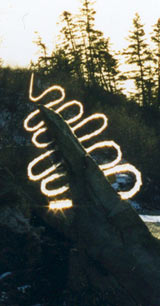
Q: What do these photographs have in common?
A: They're all the work of Andy Goldsworthy, a Scottish artist who works in and with nature using only his hands, his teeth, and, very rarely, a pocket knife.
Please join Daegu Green Living for its tenth Eco-Film showing: "Rivers and Tides," a 2003 documentary about Goldsworthy's work and the thought behind it.
From the official website:
"Landscape sculptor Andy Goldsworthy is renowned throughout the world for his work in ice, stone, leaves, wood. His own remarkable still photographs are Goldsworthy's way of talking about his often ephemeral works, of fixing them in time. Now with this deeply moving film, shot in four countries and across four seasons, and the first major film he has allowed to be made, the elusive element of time adheres to his sculpture.
"Director Thomas Riedelsheimer worked with Andy Goldsworthy for over a year to shoot this film. What Riedelsheimer found was a profound sense of breathless discovery and uncertainty in Goldsworthy's work, in contrast to the stability of conventional sculpture. There is risk in everything that Goldsworthy does. He takes his fragile work - and it can be as fragile in stone as in ice or twigs - right to the edge of its collapse, a very beautiful balance and a very dramatic edge within the film. The film captures the essential unpredictability of working with rivers and with tides, feels into a sense of liquidity in stone, travels with Goldsworthy underneath the skin of the earth and reveals colour and energy flowing through all things.
Riedelsheimer's film, like Goldsworthy's sculpture, grows into something beyond the simple making of a object. It touches the heart of what Goldsworthy does and who he is, in much the same way that Goldworthy touches the heart of a place when he works in it and leaves his mark on it.In this film, which is Goldworthy's work as much as Riedelsheimer's, 'you see something you never saw before; that was always there but you were blind to.'"
The film will start at 6:00 on Sunday, September 25th, at Buy the Book* and be followed by a group dinner, for those who are interested, at a restaurant somewhere nearby. Or, if you prefer, enjoy a healthy and delicious meal, snack, or drink off of Buy the Book's menu.
Entrance is free and open to everyone. The film doesn't have subtitles, but the language used isn't too confusing, and the Goldsworthy's art is breathtaking, even without extra explanation.
You can find the Facebook event page by looking up the group Daegu Green Living, or by following this link. Feel free to invite friends^^
Hope to see you there!
*Downtown Daegu, Rodeo Street, Mr. Pizza Building, 4th Floor.
Q: What do these photographs have in common?
A: They're all the work of Andy Goldsworthy, a Scottish artist who works in and with nature using only his hands, his teeth, and, very rarely, a pocket knife.
Please join Daegu Green Living for its tenth Eco-Film showing: "Rivers and Tides," a 2003 documentary about Goldsworthy's work and the thought behind it.
From the official website:
"Landscape sculptor Andy Goldsworthy is renowned throughout the world for his work in ice, stone, leaves, wood. His own remarkable still photographs are Goldsworthy's way of talking about his often ephemeral works, of fixing them in time. Now with this deeply moving film, shot in four countries and across four seasons, and the first major film he has allowed to be made, the elusive element of time adheres to his sculpture.
"Director Thomas Riedelsheimer worked with Andy Goldsworthy for over a year to shoot this film. What Riedelsheimer found was a profound sense of breathless discovery and uncertainty in Goldsworthy's work, in contrast to the stability of conventional sculpture. There is risk in everything that Goldsworthy does. He takes his fragile work - and it can be as fragile in stone as in ice or twigs - right to the edge of its collapse, a very beautiful balance and a very dramatic edge within the film. The film captures the essential unpredictability of working with rivers and with tides, feels into a sense of liquidity in stone, travels with Goldsworthy underneath the skin of the earth and reveals colour and energy flowing through all things.
Riedelsheimer's film, like Goldsworthy's sculpture, grows into something beyond the simple making of a object. It touches the heart of what Goldsworthy does and who he is, in much the same way that Goldworthy touches the heart of a place when he works in it and leaves his mark on it.In this film, which is Goldworthy's work as much as Riedelsheimer's, 'you see something you never saw before; that was always there but you were blind to.'"
The film will start at 6:00 on Sunday, September 25th, at Buy the Book* and be followed by a group dinner, for those who are interested, at a restaurant somewhere nearby. Or, if you prefer, enjoy a healthy and delicious meal, snack, or drink off of Buy the Book's menu.
Entrance is free and open to everyone. The film doesn't have subtitles, but the language used isn't too confusing, and the Goldsworthy's art is breathtaking, even without extra explanation.
You can find the Facebook event page by looking up the group Daegu Green Living, or by following this link. Feel free to invite friends^^
Hope to see you there!
*Downtown Daegu, Rodeo Street, Mr. Pizza Building, 4th Floor.
Thursday, September 1, 2011
New Feature: Green Guide
I've finally spent some time figuring out how google maps works, and have now managed to stick all (well, not yet, but soon) of DGL's restaurant and store reviews onto one map. Zip around and check out the options in your neck of the woods. Share it with your friends!
To visit the static DGL page with embedded map, go to http://noksaeksari.blogspot.com/p/green-guide.html
Or, to head to the map directly, it's at http://maps.google.com/maps/ms?msid=211725835272674312925.0004abea0adee14f39770&msa=0&ll=35.882931,128.682861&spn=0.159111,0.441513
To visit the static DGL page with embedded map, go to http://noksaeksari.blogspot.com/p/green-guide.html
Or, to head to the map directly, it's at http://maps.google.com/maps/ms?msid=211725835272674312925.0004abea0adee14f39770&msa=0&ll=35.882931,128.682861&spn=0.159111,0.441513
The 2011 Organic World Conference comes to Korea!
This blog tends to focus on ways that each of us can, as individuals, make environmentally responsible decisions about what we eat, where we shop, and how we entertain ourselves. Making these sort of small choices based on environmental and ethical concerns can be empowering, opening up new paths and giving us the strength to make more difficult decisions when the time comes. At the same time, though, enlightened consumers on their own won't change the world. The real movers and shakers, the ones who have the power to affect the range of possible consumption choices available to those of us who are looking to do the right thing, are those who produce, distribute, and design. Farmers, engineers, scientists, politicians, and activists. Perhaps, if we're lucky, we manage to make time to read a few articles or books on what these people are up to, and up against. For the most part, though, we're busy with our own daily lives, largely unaware of the great changes happening all around us.
This month, though, we who are here in Korea will have the opportunity to see into this world first-hand (pardon the mixed metaphor). Between Monday, September 26 and Wednesday, October 5, the city of Namyangju (Northwest of Seoul, accessible via the subway) will play host to the 17th Organic World Congress.
The schedule is as follows:
Sept 26th-27th: Pre-conferences on topics like aquaculture, urban agriculture, and tea farming
Sept 28th: Opening Ceremonies
Sept 29th - August 1st: Main conference. Lectures, seminars, and speeches on the theory, practice, politics, economics, and future of organic agriculture.
August 1st: Closing Ceremonies
August 3rd-5th: IFOAM General Assembly
While the above seem like they will mostly interest experts and practitioners, the following look like they could be interesting for just about anybody:
August 2nd: Organic tours. Choose among three different sites in Korea, all associated with different facets of the organic movement.
And, from September 28th through October 2nd: Market Festival and Organic World Fair! All sorts of booths, games, displays, shops, and concerts.
All the official details - including prices and registration info - are available on the official website, http://www.kowc2011.org/eng. No matter what aspect of the organic movement you're interested in, There will be something for you.
If you think you'd like to go, get in touch via facebook or email (noksaeksari at gmaill dot com) and we'll see if we can work out a group trip and shared accommodation at a hotel/motel/friend/couch in the area. Hope to see you there!
Subscribe to:
Posts (Atom)